
The technique
Hypopressive training, simplified
Most training methods cover one discipline at a time — a breathing course here, a posture method there, core work somewhere else. Hypopressives is the missing piece that connects them: a pressure-management technique that trains your breath, posture, fascia, deep core and nervous system as one system. Here’s how it actually works.
Pressure: the part of core training nobody taught you
Almost everything you do — coughing, lifting, running, even walking — raises the pressure inside your abdomen. That’s normal and healthy. Problems start when your body isn’t managing those pressures well: pushing them toward weak points instead of distributing them. Over time that can show up as incontinence, prolapse symptoms, hernias, or a core that never feels like it’s working with you.
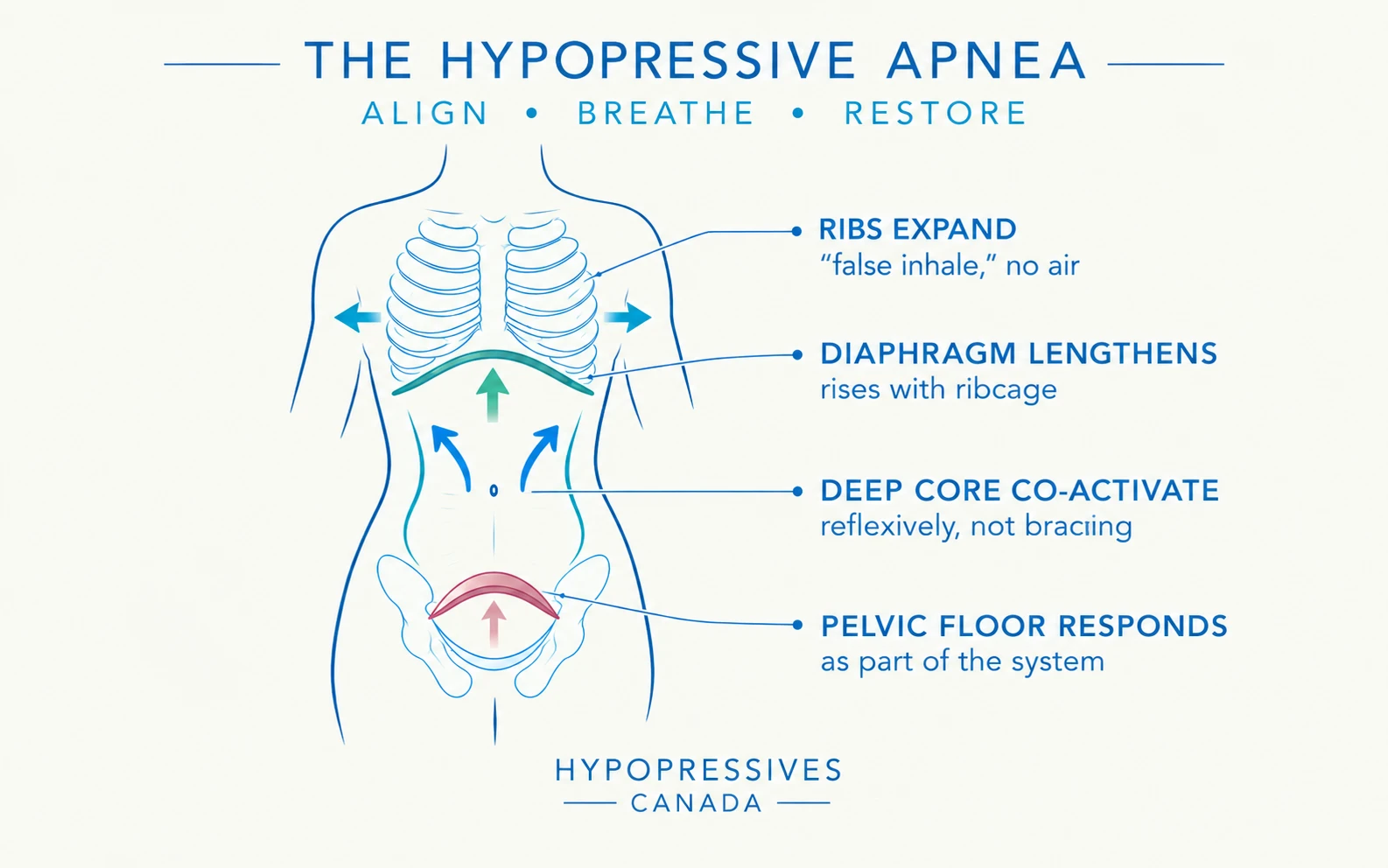
Hypopressive training doesn’t try to eliminate pressure — it retrains the team that manages it. Through specific postures and a distinctive breathing sequence ending in a “false inhale,” it triggers the reflexive co-activation of your diaphragm, deep abdominals, pelvic floor and spinal stabilizers — teaching them to coordinate automatically, the way they’re meant to.
Two different jobs
Traditional core work isn’t wrong — it’s just doing a different job. The question is whether anything in your program is training the system that manages pressure.
Traditional abdominal training
- Voluntary, phasic contraction of surface muscles
- Diaphragm pushes down with each rep
- Repeatedly raises intra-abdominal pressure
- Pelvic floor and organs absorb the load
- Trains strength and appearance
Hypopressive training
- Reflexive co-activation of the deep postural system
- Diaphragm lengthens and rises
- Trains how the body manages pressure
- Pelvic floor recruited as part of the team
- Trains coordination and function

Why one pose changes the whole body
Each Hypopressive posture is built around tensegrity — tension and integrity balanced through the entire structure. Create lengthening or pull in one area, and the effect travels through the body’s fascial network: a global stretch of muscle, fascia and connective tissue rather than an isolated one.
That’s why practitioners report changes in alignment, breathing and carriage — not just “core strength.” Improve posture and you improve breathing; improve breathing and you improve posture. The system reinforces itself.
What the research says — honestly
Hypopressives has a growing but young evidence base. Studies show improvements in deep-abdominal recruitment and quality-of-life measures, and pelvic-floor activation during practice is real and measurable. Recent research (including a 2024 University of Ottawa study) suggests the technique is best understood as training pressure management and coordination — not as a guaranteed way to lower pressure, and not a replacement for pelvic floor physiotherapy. We teach it the way the evidence supports: as a powerful complement that many clients feel the difference from.
Go deeper
Keep learning
Core competence
How the four parts of the core unit work together, and what happens when one is not doing its job.
Types of incontinence
The five main types, their symptoms and common causes.
Watch it explained
Short videos from Trista on how the technique works and who it can help.
Understanding it is step one.
Learning to use it is the career move.
Professionals learn to teach this system across three levels — think stand, walk, run.
L1 · Foundation
A billable service this week
L2 · Intermediate
Into dynamic movement
L3 · Expert
Certified & directory-listed